
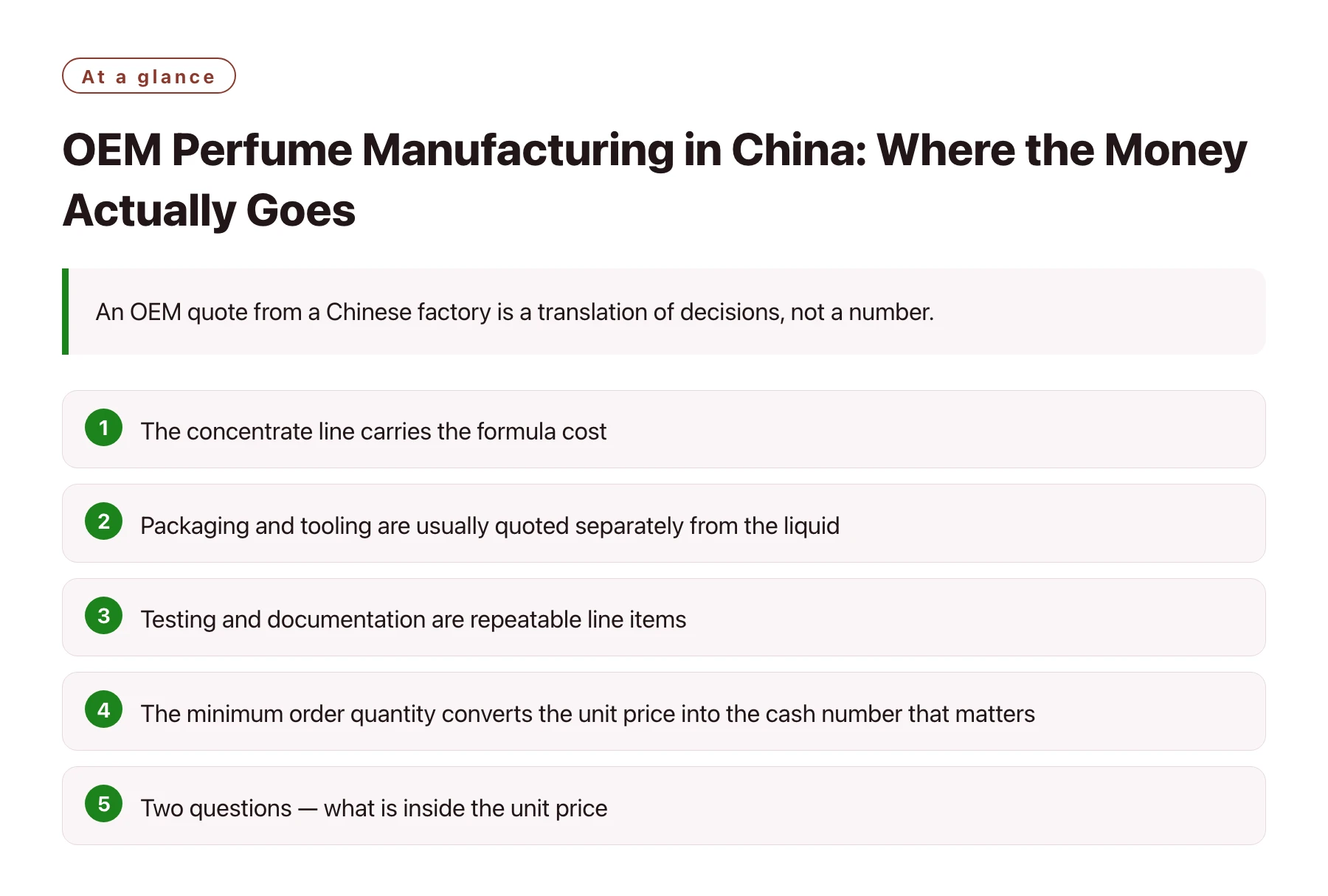
An OEM quote from a Chinese factory is a translation of decisions, not a number. The unit price is the sum of the concentrate, packaging, filling work, testing and tooling — plus the supplier's chosen minimum order — and every one of those can differ between two honest factories. A founder who can decompose the quote into those lines will find the real number; a founder who compares totals will not.
Key takeaways
- The concentrate line carries the formula cost, and it moves with oil percentage and raw material quality, not with the factory's mood.
- Packaging and tooling are usually quoted separately from the liquid, and tooling is where the biggest surprise invoices live.
- Testing and documentation are repeatable line items, and they appear in different places in different quotes.
- The minimum order quantity converts the unit price into the cash number that matters, so it belongs in the same table as the price.
- Two questions — what is inside the unit price, and what is billed separately — decompose almost any quote in under a minute.
When a founder asks a Chinese OEM factory for a price, the answer usually comes back as a single unit number with a minimum order at the end of it. The number is rarely a lie. It is almost always just incomplete.
The same brief — same oil percentage, same bottle, same carton — can be quoted far apart by two respected factories, and both quotes can be perfectly fair. The difference is not quality; it is which lines sit inside the unit price and which sit outside it.
This article breaks an OEM quote into its components, points at where the costs hide, and ends with the two questions that expose the overhead of any supplier.
The anatomy of an OEM quote
Start with the liquid. The concentrate line is the perfume oil at the agreed percentage, and its cost is set by the raw material budget of the formula. Some aroma materials cost a fraction of others, and public reference databases such as the Good Scents Company let a buyer look up odour notes and typical usage levels for the materials in a brief — which turns 'the formula is expensive' from a claim into a checkable statement [1].
Above the liquid sits packaging: bottle, cap, collar, pump, carton, label and any decoration. In OEM work this line is normally quoted separately, and it is where the quote stops being a perfume price and starts being an industrial design price.
Then come the process lines: filling and assembly, quality checks, and the document pack. A factory that compounds, fills and packs in house can price these tightly; one that subcontracts half the steps carries another supplier's margin inside the same number.
A partner whose core business is manufacturing — for example an OEM perfume manufacturer in China — should be able to list these lines from memory, because the lines are the product Xuelei OEM perfume manufacturer in China.
The cost components, side by side
| Cost component | What usually moves it | What a buyer can do |
|---|---|---|
| Concentrate | Oil percentage and raw material budget | Fix both in the brief before quoting |
| Packaging and decoration | Bottle complexity, cap, tooling, finish | Cap the tooling spend in writing |
| Filling and assembly | Decoration type and line speed | Ask how much time each step adds per bottle |
| Testing and documentation | Destination market and test programme | Demand testing as a separate line |
| Tooling and setup | Moulds, artwork plates, first-run setup | Confirm who owns the tooling and what it costs |
| Minimum order quantity | Factory policy and packaging minimums | Check the cash number, not the unit number |
Read the last column as a to-do list. Every component in this table is something a buyer can push on, and the suppliers who behave like partners are the ones who let you.
Where quotes hide the real number
The discipline of knowing where a perfume quote can hide costs applies to tooling before it applies to anything else where a perfume quote can hide costs. Moulds, artwork plates and first-run setup are real money, and they can appear inside the unit price, outside it, or not at all until the deposit is paid.
Testing is the second classic hiding place. Microbiological and stability testing performed by an independent laboratory is a standard part of professional cosmetics production, and in China OEM work it is usually a separate, per-product programme [2]. If a quote says 'testing included', split it and ask what is included — the difference between a short stability screen and a full programme is several lines on the invoice.
The third place is the minimum. A low unit price at a high minimum is not cheaper than a higher unit price at a lower minimum; it is a different cash commitment. Always multiply the unit price by the minimum before comparing two quotes.
Two questions that expose the overhead
What is inside the unit price?
Ask the factory to write out exactly which steps the unit price covers: concentrate at the agreed percentage, standard bottle and cap, filling, labelling, basic carton, and which testing. Anything not listed is outside the number, and outside the number is where budgets go to die.
What is billed separately?
Tooling, artwork setup, special decoration, extra testing, approval copies, palletisation, freight and documentation fees should all be named in advance. A supplier who can name them in one email is a supplier who has answered the question before; a scope that supports OEM and ODM usually has this list ready because both models need it a manufacturer that supports OEM and ODM.
Never negotiate a total. Negotiate lines: get the quote decomposed, move one component at a time, and watch which lines the factory defends. The lines they refuse to move are the lines where their real cost lives — and that is the information you actually need.
Sources
- The Good Scents Company —— A reference database of aroma materials with odour descriptions, CAS numbers and typical usage information.
- SGS: Cosmetics, Personal Care & Household Testing —— Testing, inspection and certification services for cosmetics and personal care, including microbiological, stability and safety testing aligned with cosmetics GMP.
Frequently asked questions
Why do two Chinese OEM factories quote the same perfume so differently?
Because the scope differs: oil percentage, packaging spec, tooling, testing programme and minimum order are all choices, and each factory prices its own combination. Decompose both quotes into the same lines before comparing anything.
Are tooling costs included in the unit price or separate?
Usually separate, and this is the single most common surprise in OEM quoting. Confirm in writing whether moulds, artwork plates and setup are inside the unit price, outside it, or shared across your first order.
Do I need to pay for testing on an OEM perfume order?
Yes — stability, microbiological and sometimes compatibility testing are standard for a compliant cosmetic product, and they are charged per product programme. The question is not whether, but where the line sits in the quote.
Is a high minimum order a sign of an unreasonable factory?
Not necessarily; minimums reflect packaging and setup economics, and a supplier who runs efficient small runs can keep them low. The mistake is comparing unit prices while ignoring the minimum, because the cash commitment is what actually limits a first project.
How can I verify the raw material quality behind a cheap quote?
Ask which materials sit in the formula and look them up in public aroma material databases — odour, typical usage and price class are usually documented. Then ask for the batch records behind the sample, which is the real evidence of what was used.